The Birqash camel market is the rawest morning you can have near Cairo, and it is not for everyone
The Birqash camel market is the rawest morning you can have near Cairo, and it is not for everyone
The Birqash camel market, Souq al Gamal to Egyptians, is the largest camel market in Egypt and sits about 22 miles northwest of central Cairo. Most of the animals come up from Sudan along the old Forty Days Road and through the market at Daraw near Aswan. It is a working livestock market, not a show: loud, dusty, sticks in use, most camels sold for meat. Trading peaks in the first hours after sunrise on the main market days, so you leave Cairo in the dark and are back before lunch, in time for Giza or Saqqara. Go if you want the unpolished Egypt. Skip it with small kids or if animal handling is hard for you to watch.
What the Birqash camel market actually is
Birqash is a village on the edge of the Nile Delta, past Imbaba and the last of Cairo's northern sprawl, where apartment blocks give way to clover fields and canals. The camel market moved out here from Imbaba in the mid 1990s, when the city grew around the old site and the animals had nowhere left to walk. The ground is a fenced compound of packed earth with a few sheds, a tea stall, a row of trucks along the wall and, on a market morning, several hundred to a couple of thousand camels.
It is the last link in a trading chain that runs from the pastures of Sudan to the butchers of Cairo, and that is the thing to understand before you go. Nothing here is staged for you. The traders are there to buy and sell, the camels are stock, and a visitor with a camera is tolerated rather than catered to. It belongs on the short list of unique experiences in Egypt for one reason: it is real.
Where the camels come from: Sudan, the Forty Days Road and Daraw
Most of the animals at Birqash were not born in Egypt. They come from the herding regions of Sudan, Kordofan and Darfur above all, and they enter Egypt by the desert route known as Darb al Arbain, the Forty Days Road. The name is the old caravan timing for the walk from the Sudanese interior to the Nile valley, and drovers still bring herds up on foot for part of it, because a camel that walks arrives cheaper than one that rides in a truck.
The first stop inside Egypt is the camel market at Daraw, a farming town on the east bank of the Nile between Kom Ombo and Aswan. Animals are sold there, rested, and the ones bound for the capital are loaded onto trucks for the long haul north along the desert highway. Birqash is where that haul ends. By the time a camel stands in the compound outside Cairo it may have covered well over a thousand miles, and it looks it.
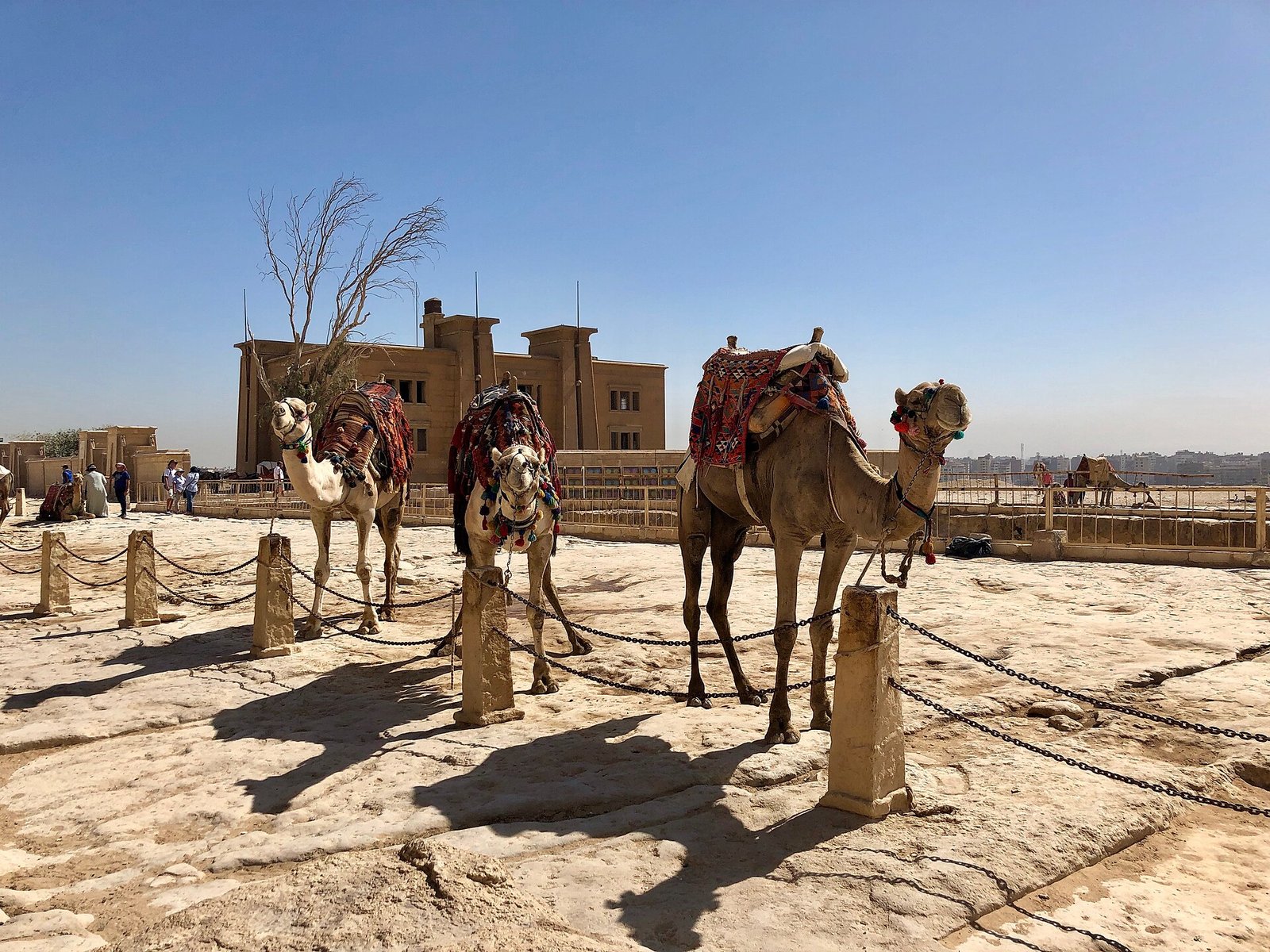
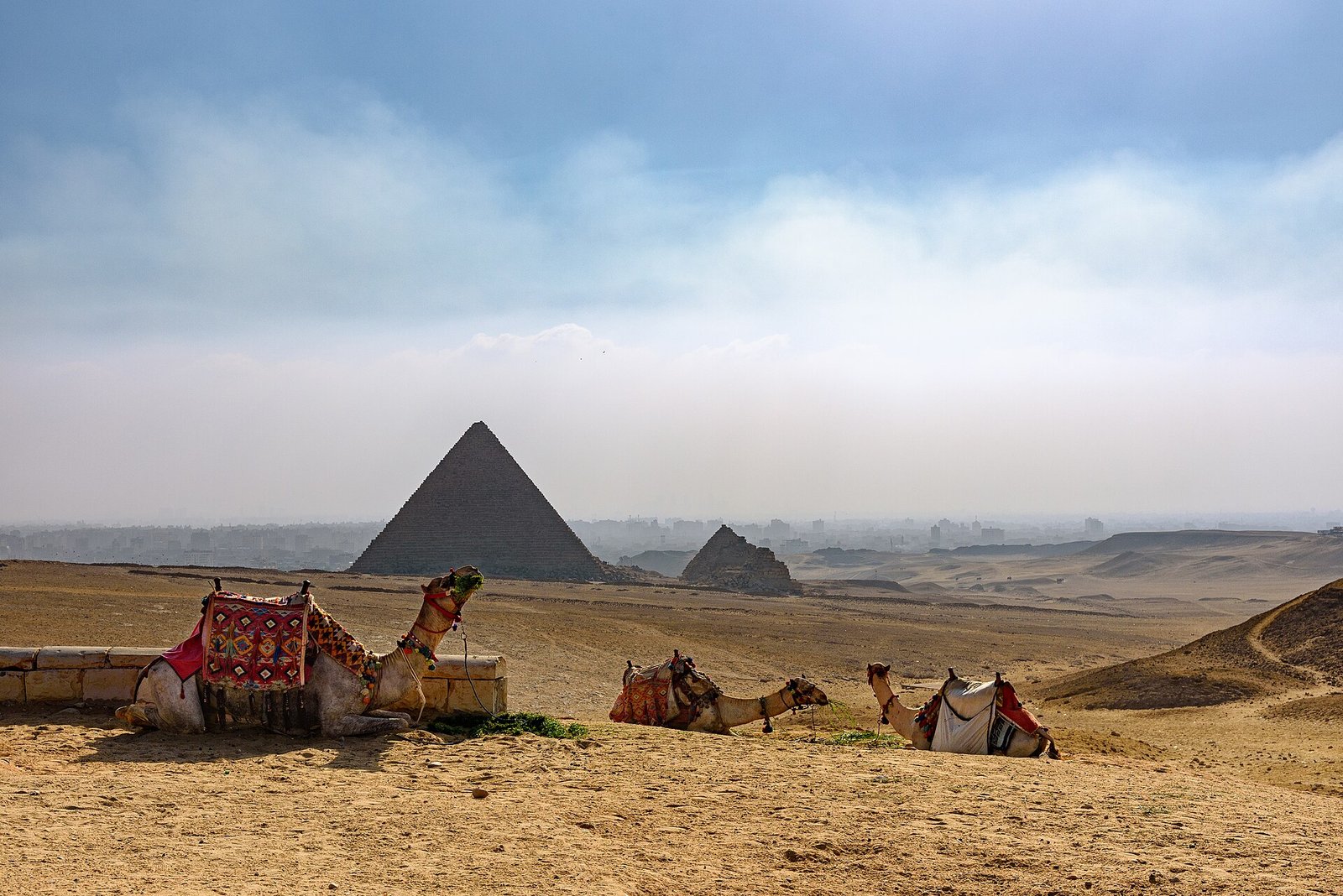
Camels are sold here overwhelmingly for meat, which is a normal butcher's meat in Egypt, cheaper than beef. A smaller share goes to farm work, and a smaller share still to the tourist stables at Giza and Luxor. If you have taken a camel ride at the pyramids, this is very likely where your animal was bought.
Market days and why you leave Cairo in the dark
Birqash has traditionally traded on Friday, its big day, with a quieter session earlier in the week. That pattern shifts. Truck schedules from the south change and religious holidays move the calendar. Treat any weekday you read online as a starting point and check the current days with us before you plan a morning around it. We call the market the week before you travel, because a drive out to an empty compound is a wasted dawn.
Whatever the day, the timing is set by the trade itself. Trucks unload before first light, the serious buying is done in the two or three hours after sunrise, and by mid morning the best animals have gone and the yard is half empty. You want to be walking in as the sun clears the horizon, which means a hotel departure in the dark and an alarm that will feel unreasonable.
The visit itself is short. Ninety minutes to two hours in the yard is plenty for most people, and that is a feature: you are back on the road toward the city before the day warms up, with the whole of it still ahead of you.
What you see once you are inside the yard
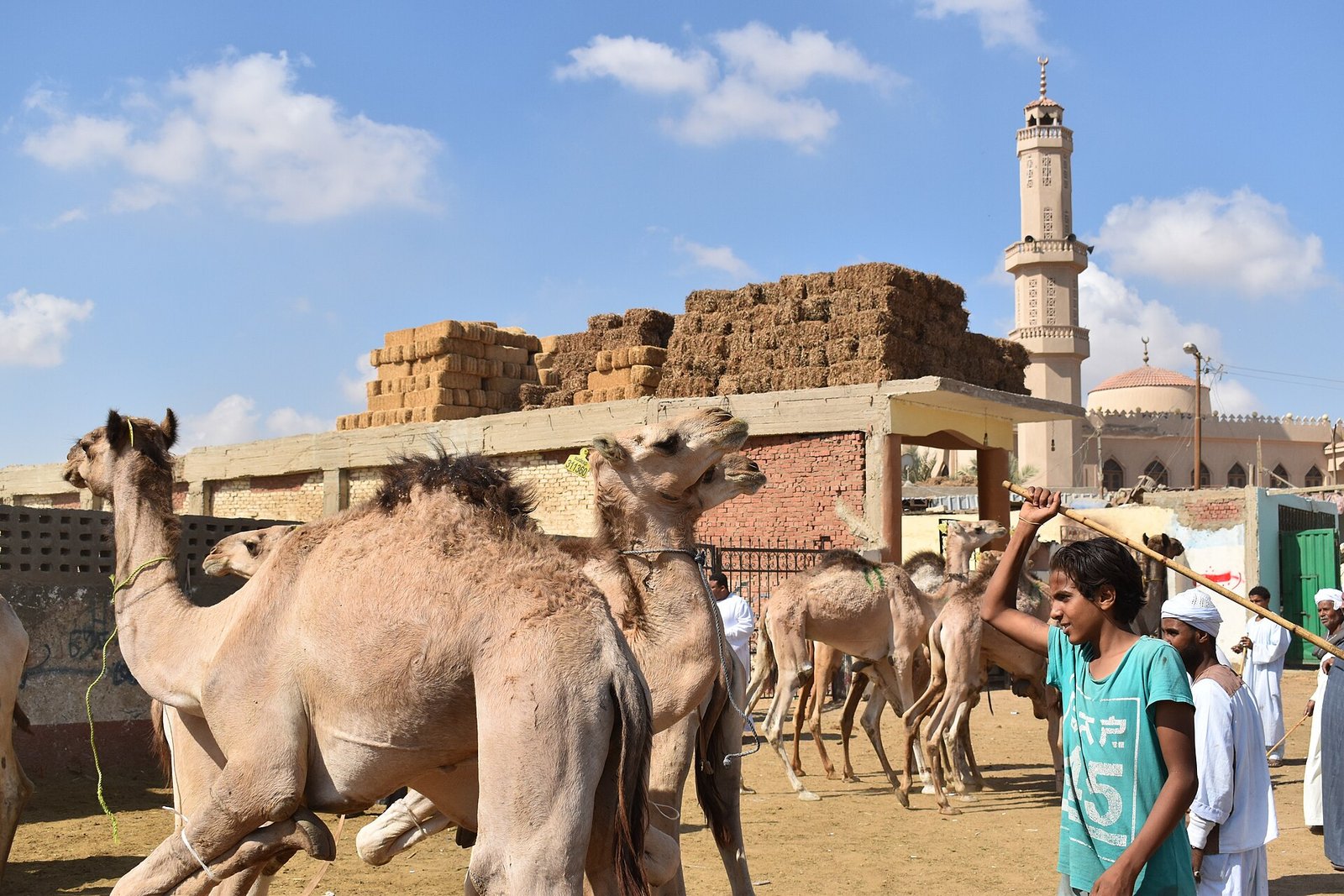
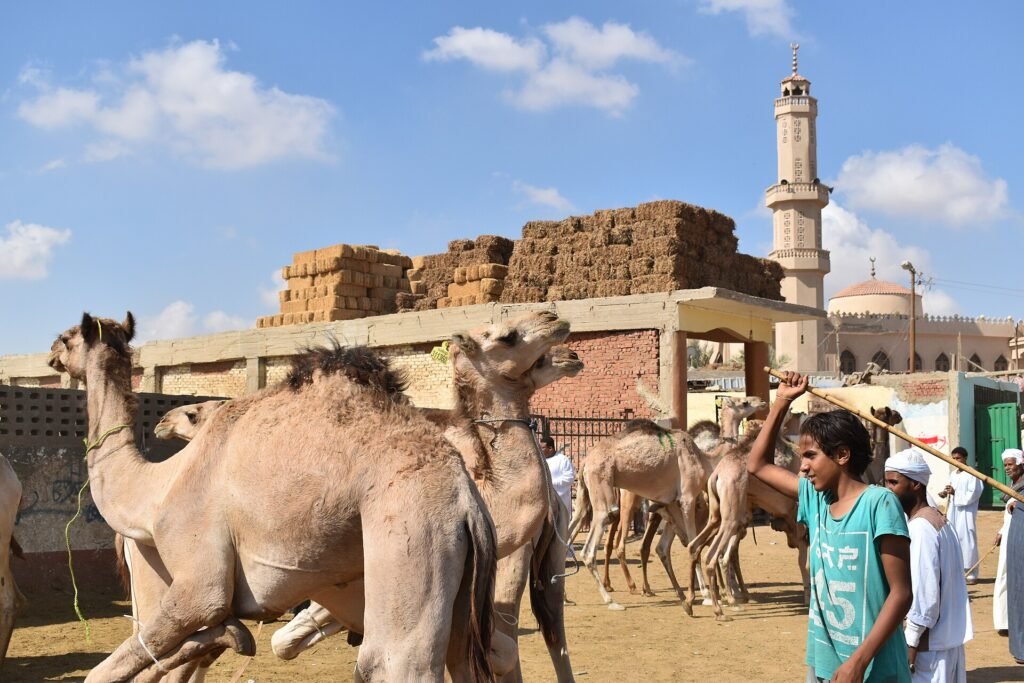
The first impression is sound. Camels groan and bellow at a pitch you feel in your chest, traders shout prices over them, and trucks reverse into the wall with their tailgates crashing down. Then the dust, which hangs in the low sun and turns the whole compound the same ochre color, and the smell, which you stop noticing after ten minutes.
Look at the animals and you will see paint. Each trader marks his stock with a splash of color on the neck or flank, so ownership is clear in a moving crowd. Many camels have one foreleg folded and tied at the knee, which keeps them from bolting and is why they hop rather than walk. That hobbling is the detail most first-time visitors find hardest, and it is worth knowing about before you see it.
The selling happens in the open. A buyer walks around an animal, prods the hump to judge its condition, checks the teeth for age, and then argues. Deals close with a handshake and a slap on the palm, and cash changes hands from bundles wrapped in cloth. Boys with sticks move the sold animals toward the trucks, and tea sellers with brass kettles work the crowd. A guide who knows the yard translates the bidding for you and tells you which traders are which, and that turns noise into a story.
The honest animal-welfare picture
We would rather you read this and decide not to come than arrive and feel ambushed. Birqash is a livestock market in a country where livestock are handled roughly. Sticks are used to move animals, and they are used hard. Camels are hobbled, tied by the neck, loaded onto trucks that are too small for them and unloaded by being pushed off the tailgate. Some arrive exhausted from the journey and are visibly in poor condition. Nobody is hiding any of this and nobody there sees it as cruelty, which is part of what makes it hard to watch.
Birqash is not worse than a cattle sale in a poor rural region anywhere in the world; it is simply closer, louder and involves an animal Americans think of as exotic rather than as dinner. Whether that context helps you is a personal question.
What we ask of our travelers is simple. Do not intervene, do not lecture a trader, and do not tip a boy to hit an animal less or to let you touch it. None of that changes anything and all of it makes the next visitor less welcome. If you want your money to reward good handling, do it at the tourist stables, where you can choose a well-kept animal and walk away from a neglected one. Birqash is for watching, and for understanding where those animals come from.
Who it suits, and who should skip it
We do not put Birqash in a program unless we think the traveler will get something out of it. The people who love it have usually seen the classic monuments already, like markets and working places more than museums, and are comfortable being the odd one out in a crowd that is not there for them.
| Traveler | Our recommendation | Better alternative |
|---|---|---|
| Photographers and documentary-minded travelers | Go, on the main market day | None needed |
| Second-time visitors who want a different Egypt | Go, combined with Saqqara or Dahshur | Fayoum or a Delta village market |
| Families with children under about 12 | Skip it | Camel ride at Giza, then the pyramids |
| Travelers sensitive to animal handling | Skip it, without guilt | A felucca on the Nile at Aswan |
| First-time visitors on a short trip | Skip it, the pyramids need that morning | Giza and Saqqara in one day |
| Anyone with mobility limits or a dust allergy | Skip it | Khan el Khalili at opening time |
Children are the one we hold firm on. A camel that panics in a crowd moves fast and does not look where it is going, and the yard has ropes underfoot, trucks backing up and men swinging sticks. Even a calm ten-year-old cannot see over the animals. Our family guide to Egypt with kids covers what does work at that age. Save Birqash for a return trip without them.
Photography and manners in a place that is not a tourist attraction
You are walking into somebody's workplace, and the rules of any workplace apply. Ask before you point a lens at a face. Most traders say yes, some ask for a small tip, a few say no, and no means no. Wide shots of the yard, the trucks and the animals need no permission. A guide who greets the traders by name changes the answer to almost every request, which is one of the two practical reasons to bring one.
Do not walk between two camels, do not stand behind one, and do not step over a rope on the ground, because the other end is attached to something that weighs a thousand pounds. Stay out of the truck lanes, and if a trader waves you back, move.
Dress for the ground, not the photos. Closed shoes you do not mind ruining, long pants, a long-sleeved shirt in a color that hides dust, a hat, nothing that dangles. Carry one camera with one lens, a telephoto if you have it, no bag and no drone. Our page on photography rules in Egypt covers the general etiquette, and nearly all of it applies here in a sharper form.
The drive from Cairo and how the morning fits with Giza or Saqqara
Birqash sits about 22 miles northwest of downtown Cairo, off the road that runs up the west bank of the Nile toward the Delta through Imbaba and Kerdasa. At dawn, with the city asleep, the drive from a central or Giza hotel takes about an hour. On the way back, with traffic building, allow closer to ninety minutes. No bus or metro is useful to a visitor and no ride-hailing driver will wait in a camel yard, so this is a private car and driver trip.
| Combination | How the morning runs | Who it suits |
|---|---|---|
| Birqash, then Giza | Market at sunrise, back toward the plateau by mid morning, pyramids and Sphinx before the heat | Travelers with only two Cairo days who still want the market |
| Birqash, then Saqqara and Dahshur | Market at sunrise, south along the desert edge to the Step Pyramid, Memphis, then the Red and Bent pyramids, village lunch | Second-time visitors and anyone who wants a full day away from crowds |
Our own preference is the second one. Saqqara and Dahshur lie in the same broad direction of travel, and the empty pyramid fields are the right antidote to the noise of the yard. The Memphis and Saqqara guide explains what is there. Either way, the market day dictates the schedule, so we fix Birqash first and arrange the rest of Cairo around it.
Daraw market near Kom Ombo, the southern alternative
If your itinerary is heavier on the south than on Cairo, or the Birqash day will not fall on a market morning, there is a second option on the same trading route. Daraw is the market the animals pass through on their way up from Sudan, on the east bank of the Nile a few miles south of Kom Ombo and about 25 miles north of Aswan. It is smaller and quieter than Birqash, with sheep, goats and donkeys sold alongside the camels, and feels more like a country fair than a trading floor.
Daraw has a market day rather than trading every morning, and that day moves just as Birqash's does, so the same rule applies: ask us to confirm before you plan. The advantage is location: a short detour off the Aswan to Kom Ombo road, so it fits a land day trip from Aswan or a private transfer to Luxor, and pairs naturally with the double temple at Kom Ombo a few minutes away.
Nile cruise passengers usually cannot do it, because the boats dock at Kom Ombo in the afternoon and the market is over by then. If you travel by road, or stay in Aswan for a couple of nights, it is a good morning. Read the Kom Ombo temple guide for the temple half of the day, and see the range of Aswan excursions for what else can be built around it.
How Explora Egipto arranges the visit
We are a local agency with our own drivers and guides in Cairo, and Birqash is a trip we build to order rather than sell off a shelf. The sequence is always the same. First we confirm the current market day for the week you are in Cairo, by phone, with people who trade there. Then we fix that morning in your program and move everything else around it. Then we send a driver who knows the back road and a guide who knows the yard and the traders.
The guide is the difference between an hour of confusion and an hour you will remember. He or she handles the small entry ticket at the gate, introduces you to a trader or two, keeps you out of the lanes, gets the yes for the photos and knows when it is time to leave.
After the market the same car takes you on to Giza, Saqqara and Dahshur, or Coptic Cairo, with a proper breakfast stop on the way. The whole thing runs as one of our Cairo excursions, on its own or folded into a longer Egypt program. The quote depends on the day, the group size and what follows the market. Send us your dates and we send you the quote.
Frequently asked questions
What days is the Birqash camel market open?
Friday has long been the main trading day, with a smaller session earlier in the week, but the pattern shifts with truck schedules from the south and with religious holidays. Ask us to check the current days for your dates; we call the market before your trip and fix the morning once it is confirmed. Arrive at sunrise whichever day you go.
How far is Birqash from Cairo and how do you get there?
About 22 miles northwest of downtown Cairo, past Imbaba on the west bank road toward the Delta. At dawn the drive takes about an hour from a central or Giza hotel; the return with morning traffic takes longer. It is a private car and driver trip, ideally with a guide who knows the traders.
Is the Birqash camel market suitable for children?
We do not recommend it for children under about 12. The yard has panicking animals, ropes underfoot, trucks reversing and rough handling that most kids find upsetting. A short camel ride at Giza followed by the pyramids gives a family the camel moment without any of that. Save Birqash for a later trip without the kids.
Can I take photos at Birqash?
Yes, of the yard, the trucks and the animals without asking. For faces, ask first; most traders agree, some expect a small tip and a few refuse. A guide who knows people there gets far more yeses than you will alone. Bring one camera and one lens, wear old closed shoes and long sleeves, and never fly a drone.
Where do the camels at Birqash come from?
Mostly from Sudan, from the herding regions of Kordofan and Darfur, by way of the desert route called the Forty Days Road. They enter Egypt at the market in Daraw, near Kom Ombo and Aswan, and are trucked north to Birqash, the last and largest market on the chain. Most are sold for meat; a few go to farms and to the tourist stables.
Is Daraw camel market a good alternative to Birqash?
Yes, if your trip is centered on Aswan and Luxor or the Birqash day does not fall on a market morning. Daraw is smaller and calmer, sells other livestock alongside the camels, and sits a few minutes from Kom Ombo temple. Its market day also moves, so confirm it with us. Cruise passengers usually miss it because boats dock at Kom Ombo in the afternoon.
See where Egypt's camels come from, then spend the day with the pyramids
Tell us your Cairo dates and who is traveling. We confirm the current Birqash market day, build the dawn run with our own driver and a guide who knows the yard, and put Giza, Saqqara or Coptic Cairo on the other side of it. Just a quote in your inbox with the market morning already placed.